Root Canal or Tooth Extraction? How Dentists Decide Which Is Right for You


You're sitting with a painful tooth, and your dentist says you have a choice. Root canal or extraction. Both sound daunting. One of them is the right call for your specific situation, and the difference between the two has real long-term consequences for your oral health.
Patients often assume extraction is the simpler, cheaper option. Sometimes it is. But "simpler now" can mean "more complicated later" if the missing tooth isn't replaced. Understanding how dentists think through this decision helps you ask better questions and walk away confident in whatever path you take.
What Is a Root Canal Treatment?
A root canal removes infected or damaged pulp tissue from inside the tooth. The pulp is the soft inner layer containing nerves and blood vessels. When bacteria reach it through deep decay or a crack, it becomes inflamed or infected, and that's usually where the significant pain comes from.
During the procedure, your dentist cleans out the infected pulp, shapes the canals, and seals them with a filling material. In most cases, a crown is placed over the tooth afterwards to restore full strength and function. The tooth itself stays in your jaw. Your bite, your bone, and your neighbouring teeth remain undisturbed.
Modern root canal treatment, particularly when done by an endodontist, is far less uncomfortable than its reputation suggests. Most patients describe the experience as comparable to having a filling done.
What Is a Tooth Extraction?
Tooth extraction is the surgical or simple removal of a tooth from its socket. Simple extractions are performed on teeth that are visible and accessible. Surgical extractions are required when a tooth is impacted, broken at the gum line, or has roots that are curved or fused to the bone.
After an extraction, the space left behind matters. Surrounding teeth can shift over time toward the gap. The jawbone in that area begins to resorb without a tooth root providing stimulation. If the extracted tooth isn't replaced, these changes can affect your bite, your facial structure, and the difficulty of future dental work.
Replacement options such as implants, bridges, or dentures each carry their own timeline and cost, so the total investment of "just pulling it" is often higher than it first appears.
Why Saving Your Natural Tooth Is Usually the First Goal
No dental replacement fully replicates the function and feel of a healthy natural tooth. Your natural tooth root stimulates the jawbone, maintains the spacing of adjacent teeth, and provides feedback when you bite and chew.
That's why most dentists, when the tooth is structurally restorable, will recommend a root canal over extraction. It keeps more of your original anatomy intact. It avoids the downstream costs of replacement. And it tends to produce better long-term outcomes for surrounding bone and gum tissue.
Keeping a tooth that can't be properly restored isn't always the right call either. A tooth with insufficient structure to support a crown, or one surrounded by compromised bone, may cause more problems if retained.
How Dentists Assess Which Option Is Right for You
The decision isn't based on a single factor. Dentists evaluate several things together before making a recommendation.
Extent of infection.
If the infection is contained within the tooth's pulp and hasn't spread significantly into the bone, a root canal is typically viable. Widespread infection affecting the surrounding bone raises more complex considerations.
Remaining tooth structure.
A root canal followed by a crown requires enough sound tooth structure to anchor the restoration. If decay or fracture has destroyed too much of the tooth above the gum line, there may not be enough left to work with.
Bone support.
Teeth that have lost substantial surrounding bone due to gum disease may not have the support needed to function reliably long-term, even after endodontic treatment.
Root anatomy.
Some teeth have canals that are unusually curved, narrow, or calcified, which can complicate root canal treatment. An endodontist has the training and instruments to navigate these cases, but in rare instances, the anatomy makes successful treatment significantly harder.
Tooth position and function.
Not every tooth carries equal importance in your bite. A back molar anchoring a bridge or supporting your chewing function warrants more effort to save than a tooth in a less critical position.
Your overall health and dental goals.
If you're planning implants or other restorative work, that context shapes the recommendation. Your dentist considers your full picture, not just the one tooth.
Root Canal vs Tooth Extraction at a Glance
| Factor | Root Canal | Tooth Extraction |
|---|---|---|
| Natural tooth retained | Yes | No |
| Number of visits | 1 to 2 (plus crown) | 1 (simple) or 2+ (surgical) |
| Immediate cost | Higher | Lower |
| Long-term cost | Lower (no replacement needed) | Higher (if replacement required) |
| Bone preservation | Yes, root remains | No, gradual bone loss |
| Recovery time | Mild soreness, 1 to 3 days | 3 to 7 days, longer for surgical |
| Best suited for | Saveable teeth with intact structure | Teeth beyond restoration |
What Happens When You Arrive With a Problem Tooth
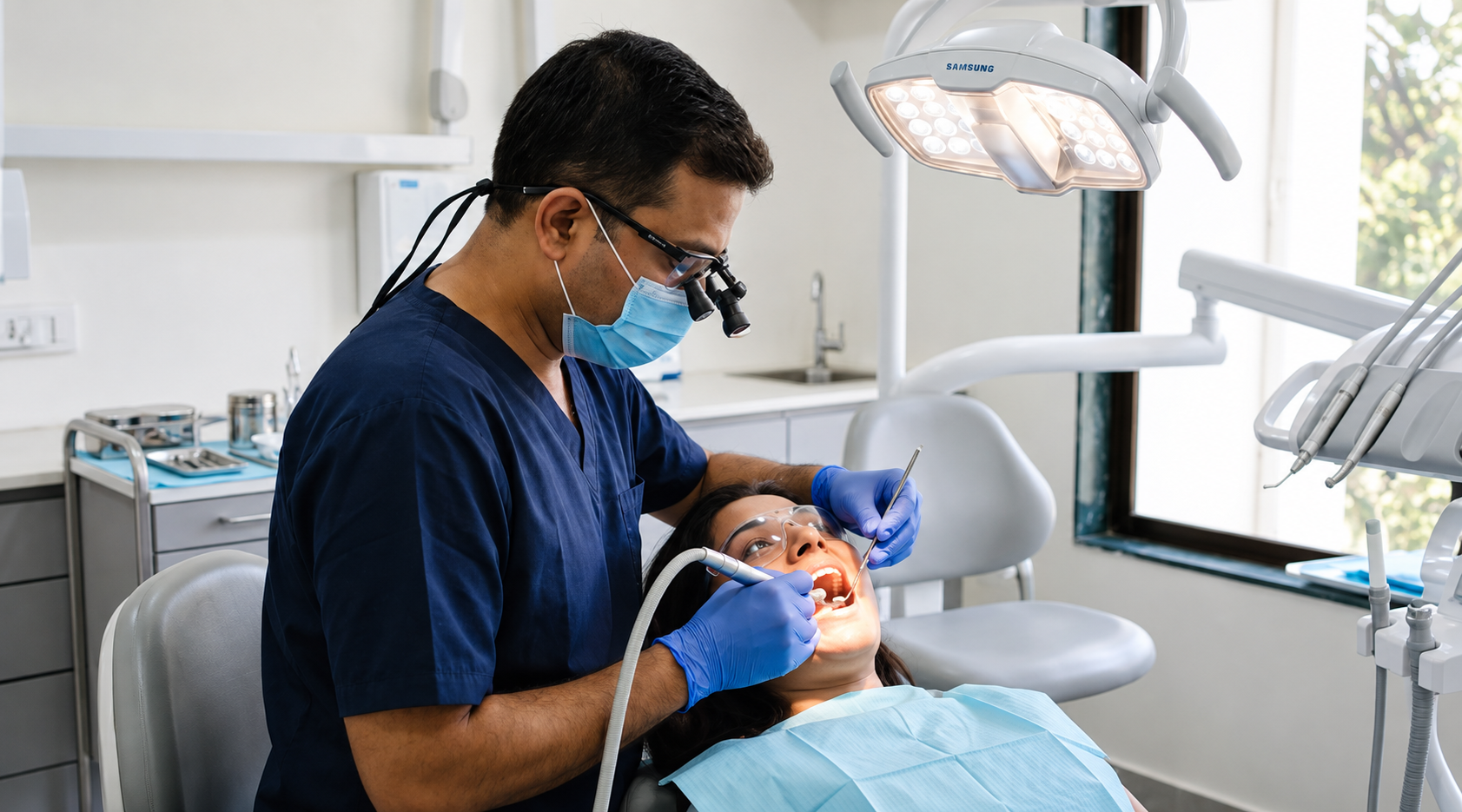
Step 1: Clinical examination.
Your dentist looks at more than just the painful tooth. They check the surrounding gum tissue for swelling or signs of an abscess, feel along the jaw for tenderness, and assess whether the infection has spread beyond the tooth itself. This first look shapes everything that follows.
Step 2: Dental X-rays and imaging.
Radiographs reveal how far infection has spread, the condition of the roots, and bone levels around the tooth. At Glee Dental, diagnostic imaging is handled in-house by Dr. Kiruthika Koteeswaran, an Oral Medicine and Dental Radiologist, so the reading of your scans is done by someone trained specifically in dental radiology, not passed to a third party.
Step 3: Pulp vitality testing.
If it isn't already clear from your symptoms, your dentist will test how the tooth's nerve responds. This might involve a cold stimulus or gentle pressure applied to the tooth. The response, or lack of one, helps confirm whether the pulp is still alive, inflamed, or already necrotic.
Step 4: Structural assessment.
A root canal is only worthwhile if there's enough sound tooth structure left to support a crown afterwards. Your dentist evaluates the amount of remaining healthy tooth above and below the gum line. A tooth that's fractured too far down, or that's lost too much structure to decay, may not have enough to anchor a restoration even if the root itself is treatable.
Step 5: Honest treatment discussion.
You'll be told exactly what was found, what your options are, and what each one involves in terms of procedure, visits, and cost. Glee Dental's approach is to provide a clear treatment plan and cost estimate up front before any work begins, so you're not making decisions under pressure or without full information.
Step 6: Treatment by the right specialist.
Once the recommendation is confirmed, treatment is carried out by the appropriate specialist. Whether that's endodontic care to save the tooth or a surgical extraction, you'll be in experienced hands with a clear plan already in place.
Step 7: Restoration or replacement planning.
After a root canal, the next step is usually a dental crown to protect and restore full function to the tooth. If extraction was necessary, your dentist will discuss replacement options, which may include dental implants, fixed partial dentures, or removable partial dentures depending on your situation. All of these are services available at Glee Dental.
When Extraction Is the Right Decision
There are situations where extraction is genuinely the correct clinical path, and a good dentist will be direct with you about it.
A tooth may need to come out in any of these situations:
-
The crown has fractured below the gum line with no viable structure remaining
-
Bone loss from gum disease has progressed to the point where the tooth is mobile and no longer functional
-
An infection has spread into the surrounding jaw and extraction is required as part of managing it
-
The tooth is being removed as part of an orthodontic plan to create space for alignment
In these cases, extraction isn't a shortcut. It's the appropriate treatment. The conversation then shifts to what replacement option fits your situation, budget, and timeline.
When Root Canal Treatment Is the Right Decision
A root canal is typically the recommended path when the tooth has sufficient structure remaining, the infection is localised, the roots are intact and accessible, and there's adequate bone support.
It's also the preferred choice when the tooth plays a significant functional role in your bite, or when it anchors existing dental work such as a bridge. Preserving it avoids more complex downstream treatment.
Many patients who choose root canal over extraction are glad they did. The tooth continues to function as normal, there's no gap to manage, and the surrounding bone stays stable.
Questions Patients Often Ask
Modern root canal treatment under proper local anaesthesia is no more uncomfortable than most other dental procedures. The pain most people associate with root canals comes from the infection itself, not the treatment. Once the tooth is numb and the infected tissue is removed, significant relief typically follows within a day or two.
Making the Right Call for Your Tooth
The choice between a root canal and an extraction comes down to the specific condition of your tooth, the state of the surrounding bone, and your longer-term dental plans. It's not a decision made on cost alone, or on reputation alone, and it shouldn't be made without a proper clinical assessment.
At Glee Dental in Adambakkam, root canal treatment is performed by an in-house endodontist. Extractions, where necessary, are handled by an oral and maxillofacial surgeon. Both conversations happen in the same clinic, without referrals and without pressure.
Contact us to book a consultation and find out exactly where your tooth stands.


Have a Dental Concern or Need a Specialist Opinion?
Whether you are deciding between saving a tooth with a root canal or exploring implants and aligners, our doctors in Adambakkam are here to guide you with honest assessments and no pressure.